
Quick answer
This Student Recruitment CRM Guide explains how education agencies, student recruitment companies and admissions teams can use CRM software to manage leads, student enquiries, applications, documents, follow-ups, counsellor activity, university communication and enrolment tracking in one place. A well-planned student recruitment CRM helps teams reduce manual work, avoid missed follow-ups and improve visibility across the full student journey.
Contents
- Student Recruitment CRM Guide: Overview
- What Is a Student Recruitment CRM?
- Why Student Recruitment Agencies Need a CRM
- Essential Features of a Student Recruitment CRM
- Student Recruitment CRM Workflow
- Custom CRM vs Ready-Made CRM for Student Recruitment
- Benefits of Student Recruitment CRM Software
- Reporting and Data Visibility
- Automation Ideas for Student Recruitment
- How to Implement a Student Recruitment CRM
- Common CRM Mistakes to Avoid
- How SaaS Infinity Can Help
- Frequently Asked Questions
- Final Thoughts
Student Recruitment CRM Guide: Overview
Student recruitment is a fast-moving process. Education agencies and admissions teams often handle enquiries from many channels, including website forms, social media, WhatsApp, email, phone calls, education fairs, referral partners and walk-in visitors. Without a proper system, it becomes difficult to track which student has been contacted, which documents are missing, which university has been applied to and which counsellor is responsible.
This is where a student recruitment CRM becomes valuable. A CRM helps bring student leads, communication history, application stages, documents, follow-up reminders and reporting into one organised platform. Instead of using spreadsheets, WhatsApp messages and scattered email threads, the team can work from a single system.
This Student Recruitment CRM Guide is written for education consultants, student recruitment agencies, overseas education companies, training providers and admissions-focused businesses that want to improve their enquiry handling and application management process.
A good CRM is not just a contact database. It should support the full student journey from first enquiry to consultation, course selection, university application, offer letter, visa support, enrolment and post-arrival communication.
At SaaS Infinity, we help businesses plan, design and build custom CRM systems, student portals, web applications, SaaS platforms, AI tools and automation systems that fit real business workflows.
Important note
A student recruitment CRM should be designed around your actual process. Before choosing a system, map your lead sources, student stages, documents, counsellor responsibilities, university partners, compliance requirements and reporting needs.
What Is a Student Recruitment CRM?
A student recruitment CRM is software that helps education businesses manage student enquiries, applications, communication and admissions activity. CRM stands for Customer Relationship Management, but in student recruitment it is more accurate to think of it as a complete student relationship and application management system.
A standard CRM may manage contacts and sales pipelines. A student recruitment CRM goes further by supporting education-specific workflows such as course preferences, destination country, university selection, document checklist, application progress, offer status, visa stage, agent commission and counsellor performance.
A CRM for student recruitment can help manage:
- Student enquiries and lead sources
- Course and destination preferences
- Counsellor assignment and follow-up tasks
- Document collection and verification status
- University applications and offer letters
- Visa support stage tracking
- Email, SMS or WhatsApp communication history
- Partner university and agent records
- Student portal or applicant dashboard
- Reports for leads, applications, conversions and enrolments
For growing education agencies, the CRM becomes the central operating system for the recruitment team. It helps management see what is happening across all enquiries and applications without relying on manual updates.
Why Student Recruitment Agencies Need a CRM
Many student recruitment agencies start with spreadsheets, phone notes and WhatsApp communication. This can work when the business has a small number of enquiries. However, once lead volume increases, manual tracking becomes risky.
Without a CRM, common problems include:
- Leads are missed or contacted too late.
- Students receive inconsistent information.
- Documents are collected but not tracked properly.
- Counsellors forget follow-up dates.
- Management cannot see the real pipeline.
- Applications are delayed because of missing documents.
- Offer letters and visa stages are not updated clearly.
- Marketing teams cannot see which channels generate quality leads.
- Commission tracking becomes difficult.
- Reports are created manually and may contain mistakes.
A student recruitment CRM solves these problems by giving every lead and applicant a clear record. The team can see who owns the student, what stage they are in, what action is due next and what documents are still required.
For education businesses, speed matters. A student who is not followed up quickly may contact another agency. A missing document can delay an application. A missed visa update can damage trust. A CRM helps reduce these risks.
Essential Features of a Student Recruitment CRM
A good student recruitment CRM should match the way education agencies actually work. The system should be practical, easy to use and flexible enough to manage different student stages.
| Feature | Why It Matters |
|---|---|
| Lead management | Tracks student enquiries from website, social media, WhatsApp, email, calls and referrals. |
| Counsellor assignment | Assigns each student to a counsellor with tasks, notes and follow-up reminders. |
| Application pipeline | Shows each student’s stage from enquiry to application, offer, visa and enrolment. |
| Document checklist | Tracks passports, academic documents, English test results, financial documents and other required files. |
| Communication history | Keeps records of calls, emails, messages and notes so the team can understand the full student history. |
| Reporting dashboard | Helps management track leads, conversions, counsellor performance and enrolment outcomes. |
1. Lead capture from multiple channels
Student enquiries can come from many places. A CRM should capture leads from website forms, landing pages, Facebook ads, Google ads, WhatsApp campaigns, education fairs, referral partners and manual entry.
Each lead should include useful details such as name, phone number, email, preferred country, intended course, education level, lead source, counsellor and enquiry date.
2. Student profile and academic information
A student recruitment CRM should store more than contact details. It should include academic background, English language test score, preferred intake, budget, destination country, course preference and application notes.
This helps counsellors recommend suitable courses and universities based on the student’s profile.
3. Application and document tracking
Document management is one of the most important parts of student recruitment. A CRM should help the team see which documents have been collected and which are still missing.
Useful document categories may include passport, academic certificates, transcripts, CV, personal statement, reference letters, English test certificates, financial documents and visa-related files.
4. Follow-up reminders
Student recruitment depends heavily on timely follow-up. A CRM should allow counsellors to schedule tasks and reminders for calls, messages, document requests, application updates and visa support.
This reduces the chance of losing students because nobody followed up at the right time.
5. University and partner management
Education agencies often work with multiple universities, colleges, pathway providers and partner institutions. A CRM can help manage partner details, course information, commission rules, application contact points and agreement notes.
Student Recruitment CRM Workflow
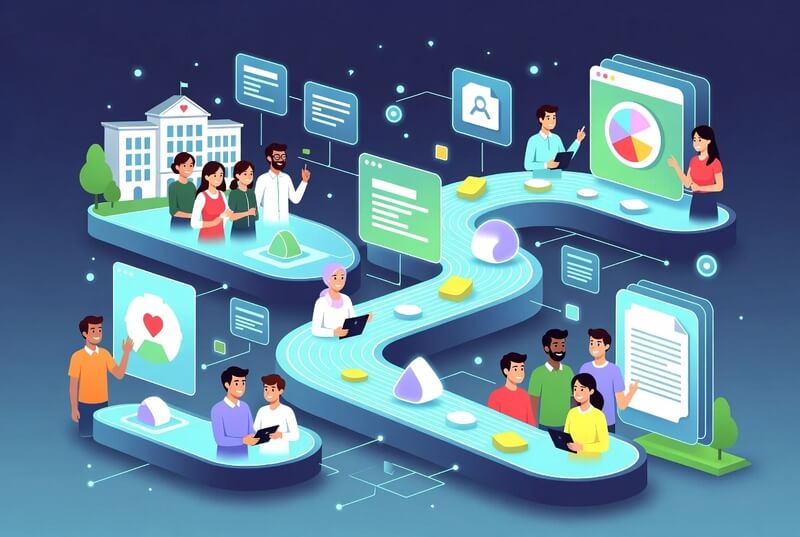
A well-designed CRM should follow the student recruitment journey. The exact workflow may vary by agency, but a common pipeline may look like this:
- New enquiry received
- Initial contact made
- Student consultation completed
- Course or university shortlisted
- Documents requested
- Documents received and checked
- Application submitted
- Conditional or unconditional offer received
- Deposit or acceptance stage
- Visa documentation support
- Visa decision updated
- Enrolment confirmed
- Post-arrival support
Each stage should have clear actions, required documents and responsible team members. This makes the CRM practical rather than just a digital spreadsheet.
For example, when a student moves to “Documents Requested,” the CRM can automatically create a checklist and remind the counsellor after a few days. When an offer letter is received, the system can update the application status and notify the team.
Custom CRM vs Ready-Made CRM for Student Recruitment
Education agencies can either use a ready-made CRM or build a custom student recruitment CRM. Both options can work, but they are suitable for different situations.
| Factor | Custom Student Recruitment CRM | Ready-Made CRM |
|---|---|---|
| Workflow fit | Built around your exact student journey, documents and application stages. | May need workarounds to fit student recruitment processes. |
| Setup speed | Takes longer because it is planned and developed for your business. | Usually faster to start. |
| Cost | Higher upfront investment, but more control and flexibility. | Lower upfront cost, but monthly fees and add-ons may increase over time. |
| Scalability | Can grow with branches, teams, portals and automation. | Limited by platform features, plans and integrations. |
| Best for | Agencies with unique workflows, multiple counsellors, branches or partner institutions. | Small teams with simple CRM needs. |
If your student recruitment process is simple, a ready-made CRM may be enough. If your agency needs custom stages, document rules, partner management, student portals, counsellor dashboards and reporting, a custom CRM may be a better long-term choice.
Benefits of Student Recruitment CRM Software
A student recruitment CRM can improve both team productivity and student experience. When information is organised, the team can respond faster and make better decisions.
1. Faster lead response
When a new enquiry enters the CRM, it can be assigned quickly to a counsellor. The counsellor can see the source, student interest and contact details immediately.
2. Better student experience
Students often need regular updates. A CRM helps ensure that follow-ups, document requests and application updates are not missed.
3. Improved counsellor performance tracking
Management can see how many leads each counsellor handles, how many follow-ups are completed, how many applications are submitted and how many enrolments are confirmed.
4. Stronger marketing insight
A CRM can show which lead sources generate serious applicants. This helps the agency spend marketing budget more wisely.
5. Reduced manual admin
Instead of manually updating spreadsheets, teams can manage records, reminders, notes and applications in one system.
Reporting and Data Visibility
Reporting is one of the biggest advantages of using a CRM. Instead of asking each counsellor for manual updates, management can view real-time dashboards.
Useful reports may include:
- Total leads by source
- Leads by destination country
- Leads by counsellor
- Applications submitted
- Offer letters received
- Visa stage updates
- Enrolment conversion rate
- Lead-to-application conversion
- Application-to-enrolment conversion
- Marketing campaign performance
- Partner university performance
These reports help business owners understand where growth is coming from and where the process is breaking down.
Automation Ideas for Student Recruitment
A modern CRM can automate repetitive parts of the student recruitment process. Automation should not replace human counselling, but it can reduce admin workload and improve consistency.
Useful automation ideas include:
- Automatic lead assignment based on location or course interest
- Follow-up reminders for counsellors
- Document request emails or messages
- Application status update notifications
- Offer letter received alerts
- Visa stage reminders
- Inactive lead follow-up sequences
- Marketing campaign tagging
- Monthly counsellor performance reports
- Student portal notifications
Automation is especially useful when agencies manage high lead volume across several counsellors, branches or destinations.
How to Implement a Student Recruitment CRM
A CRM project should start with planning. The technology should follow the workflow, not the other way around.
Step 1: Map your student journey
Write down every stage from first enquiry to enrolment. Include lead source, consultation, course selection, documents, application, offer, visa and enrolment.
Step 2: Define user roles
Decide who will use the CRM. Common roles include admin, counsellor, branch manager, admissions officer, finance team, marketing team and director.
Step 3: Prepare data fields
Decide what information should be collected for each student. Avoid collecting unnecessary data, but make sure the team has the information needed to support the student properly.
Step 4: Set up document checklists
Create document checklists for different destinations, universities or application types. This helps counsellors keep track of missing files.
Step 5: Train the team
A CRM only works if the team uses it properly. Train counsellors and managers on how to update records, add notes, schedule follow-ups and move students through the pipeline.
Common CRM Mistakes to Avoid
A CRM can fail if it is not planned properly. Avoid these common mistakes:
- Choosing software before mapping the recruitment workflow
- Using generic CRM stages that do not match student applications
- Not training counsellors properly
- Not keeping student records updated
- Adding too many unnecessary fields
- Not setting clear follow-up rules
- Ignoring document management
- Not tracking lead sources accurately
- Not connecting website forms or landing pages
- Not reviewing reports regularly
The best CRM is one that the team actually uses every day. It should be simple enough for counsellors and powerful enough for management.
How SaaS Infinity Can Help
SaaS Infinity helps education businesses, agencies and service companies build custom CRM systems, student portals, web applications and automation tools designed around real workflows.
If you are looking for a practical student recruitment CRM solution, SaaS Infinity can help with:
- Student recruitment CRM planning
- Workflow mapping and CRM strategy
- Custom CRM development
- Lead capture form integration
- Student application pipeline development
- Document upload and checklist modules
- Counsellor dashboards
- Management reporting dashboards
- Student portal development
- Email, SMS or WhatsApp integration planning
- Website and landing page integration
- Ongoing support and CRM improvement
SaaS Infinity can also support your wider digital growth through software development, web development, mobile app development, SaaS platform development, AI solutions and digital marketing.
Need a student recruitment CRM?
SaaS Infinity can help you plan, design and build a CRM system that manages student leads, applications, documents, counsellor activity and reporting in one place.
Contact SaaS Infinity
to discuss your CRM project.
Frequently Asked Questions
What is a student recruitment CRM?
A student recruitment CRM is software that helps education agencies manage student enquiries, applications, documents, communication, counsellor tasks and enrolment tracking.
Why do education agencies need a CRM?
Education agencies need a CRM to manage leads properly, avoid missed follow-ups, track applications, organise documents and improve visibility across the student recruitment process.
What features should a student recruitment CRM include?
Important features include lead management, student profiles, counsellor assignment, application pipeline, document checklist, communication history, reporting dashboards and automation.
Is a custom CRM better for student recruitment?
A custom CRM can be better if your agency has specific workflows, multiple counsellors, document rules, partner universities, student portals or reporting needs that generic CRM tools cannot support properly.
Can SaaS Infinity build a student recruitment CRM?
Yes. SaaS Infinity can help plan, design and develop a custom student recruitment CRM based on your agency’s workflow, lead sources, application stages and reporting needs.
Can a student recruitment CRM connect with my website?
Yes. A CRM can be connected with website forms, landing pages, campaign pages and enquiry forms so new leads enter the system automatically.
Final Thoughts
This Student Recruitment CRM Guide shows why CRM software is important for modern education agencies and student recruitment businesses. A well-planned CRM helps teams manage leads, applications, documents, follow-ups and reporting more effectively.
If your agency is still using spreadsheets, WhatsApp messages and manual reminders, it may be time to consider a more structured system. A student recruitment CRM can help reduce missed opportunities, improve student communication and give management better visibility.
The right CRM should match your actual workflow. It should support counsellors, admissions staff, managers and students throughout the recruitment journey.
SaaS Infinity helps businesses build custom CRM systems, student portals, web applications, mobile apps, SaaS platforms, AI solutions and digital growth systems designed around real business needs.
Methodology and Source Notes
This article has been written as a practical CRM guide for student recruitment agencies and education businesses. It uses SaaS Infinity’s software development context and common student recruitment workflow considerations, including lead management, document tracking, application stages, counsellor performance and CRM automation.