
How Much Does Custom Software Cost in the UK? Full Pricing Guide for Businesses
Quick answer
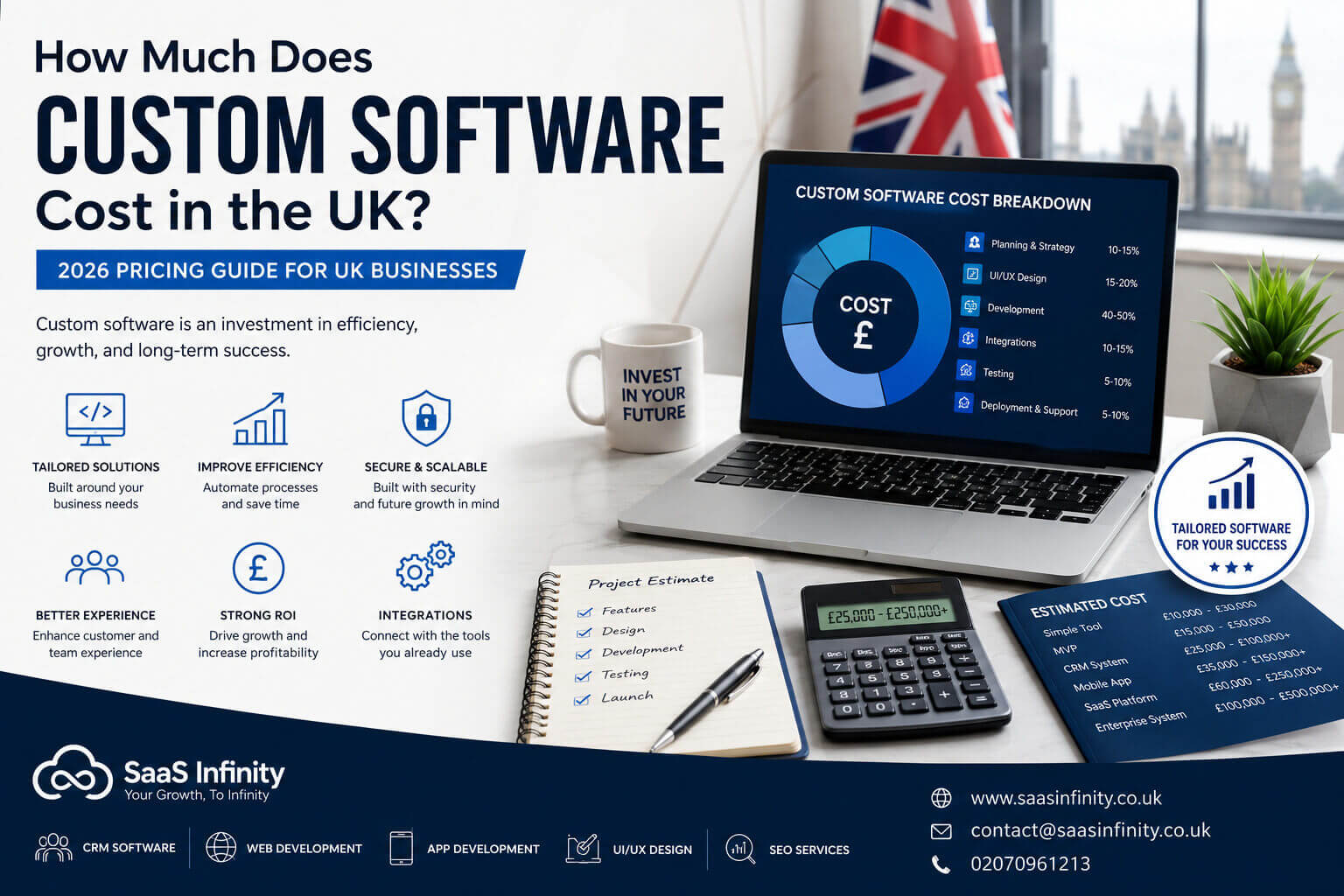
Custom software cost in the UK can range from around £10,000 to £500,000+, depending on the project size, features, design quality, integrations, security requirements, hosting, support and long-term scalability. A simple internal business tool may start from around £10,000 to £30,000, while a bespoke CRM, SaaS platform, mobile app or enterprise system can cost significantly more.
Contents
- How Much Does Custom Software Cost in the UK?
- Quick Custom Software Cost Table
- What Is Custom Software?
- Why Custom Software Costs Vary
- Custom Software Cost by Project Type
- Common Software Pricing Models in the UK
- Hidden Costs to Consider
- How to Reduce Custom Software Cost
- How to Choose a Software Development Company
- How SaaS Infinity Can Help
- Frequently Asked Questions
- Final Thoughts
How Much Does Custom Software Cost in the UK?
One of the most common questions UK businesses ask before starting a digital project is: how much does custom software cost in the UK? The honest answer is that the cost depends on what you want the software to do, how complex the system is, who will use it, how secure it needs to be and how much support you require after launch.
A small internal tool used by one team may cost much less than a full SaaS platform used by thousands of customers. A simple admin dashboard may need only a few screens, while a complex CRM, booking system, marketplace, mobile app or enterprise platform may require user roles, payment systems, reporting, automation, API integrations, cloud hosting, security testing and ongoing maintenance.
For many businesses, the real question is not only “what is the cheapest price?” but “what value will this software create?” Well-planned bespoke software can reduce manual work, improve customer service, connect departments, automate repetitive tasks, increase operational visibility and support long-term growth.
At SaaS Infinity, we help businesses plan, design and build custom software, websites, mobile apps, SaaS platforms, AI solutions and digital marketing systems that are aligned with real business goals.
Important note
The prices in this guide are practical estimates only. The final cost of custom software development in the UK depends on your exact requirements, development approach, project timeline, design expectations, integrations, hosting setup and long-term support needs.
Quick Custom Software Cost Table
The table below gives a practical overview of typical custom software cost UK ranges. These figures are not fixed prices, but they can help you understand the likely budget level for different types of projects.
| Type of Custom Software | Estimated UK Cost | Best For |
|---|---|---|
| Simple internal business tool | £10,000 – £30,000 | Replacing spreadsheets or manual admin |
| MVP software development | £15,000 – £50,000 | Startups testing a product idea |
| Bespoke CRM software | £25,000 – £100,000+ | Sales teams, agencies and service businesses |
| Custom booking or management system | £25,000 – £120,000+ | Healthcare, hospitality, education and service businesses |
| Mobile app development | £35,000 – £150,000+ | Customer-facing apps and field staff tools |
| SaaS platform development | £60,000 – £250,000+ | Subscription-based software businesses |
| Enterprise software system | £100,000 – £500,000+ | Large organisations and complex operations |
What Is Custom Software?
Custom software, also known as bespoke software, is a digital system built specifically for one business or one type of business process. Unlike off-the-shelf software, which is made for a wide audience, custom software is designed around your exact workflow, customers, staff, data and commercial goals.
Examples of custom software include:
- Customer relationship management systems
- Booking and appointment platforms
- Client portals and customer dashboards
- Internal admin systems
- Mobile apps for customers or staff
- Stock and inventory management systems
- Lead management and sales pipeline systems
- Finance, reporting and analytics dashboards
- HR and staff management tools
- SaaS platforms and subscription software products
- AI-powered automation tools
- API integrations between existing platforms
For example, a recruitment agency may need software to manage candidates, clients, interviews, compliance documents and placement tracking. A hospitality business may need a booking system that connects with payments, staff scheduling and customer communication. A utility broker may need a CRM that tracks leads, bills, suppliers, renewals and commission reporting.
The main advantage of bespoke software is control. You are not forced to change your business process to fit a generic tool. Instead, the system is built around how your business actually works.
Why Custom Software Costs Vary
The cost of custom software development in the UK varies because every project has different requirements. A basic tool may only need login, data entry and reporting. A larger system may need customer accounts, staff roles, payment integration, automation, advanced search, notifications, document uploads, data migration and a secure cloud setup.
1. Project size and complexity
The bigger the project, the more time it takes to plan, design, develop, test and launch. A small internal tool may take a few weeks or months, while a complex SaaS product or enterprise platform may take several months or longer.
Complexity usually increases when the software has multiple user types, approval workflows, reporting dashboards, automation rules, integrations or high security requirements.
2. Number of features
Every feature has a cost because it requires planning, design, coding, testing and support. A system with five essential features will cost much less than a platform with thirty advanced features.
Common features that affect cost include:
- User registration and login
- Admin dashboard
- Customer dashboard
- Staff dashboard
- Role-based permissions
- Document upload
- Payment integration
- Email, SMS or WhatsApp alerts
- Search and filtering
- Reporting and analytics
- API integrations
- Audit logs and security controls
3. UI and UX design
Good software is not only about code. It must be easy to use. UI and UX design affect how users move through the system, complete tasks, understand information and avoid mistakes.
A simple admin tool may only need a clean functional interface. A customer-facing SaaS platform, mobile app or booking system may require detailed wireframes, brand-focused design, responsive layouts, user testing and polished visual design.
4. Web app, mobile app or both
A web application is usually more cost-effective than building separate native apps for iOS and Android. However, a mobile app may be needed if your users require push notifications, GPS, camera access, offline usage or mobile-first user experience.
Some businesses start with a responsive web app first, then add mobile apps later when the product has proven demand.
5. Third-party integrations
Many businesses need custom software that connects with existing tools. Integrations can include payment gateways, accounting software, CRM platforms, email systems, calendar tools, supplier portals, analytics platforms and marketing tools.
Integrations increase cost because they require API work, data mapping, error handling, testing and ongoing maintenance.
6. Data migration
If your business already uses spreadsheets, old software or another CRM, your data may need to be moved into the new system. Data migration can include cleaning old data, removing duplicates, mapping fields, importing files and testing accuracy.
Poor data migration can create serious business problems, so it should be planned carefully from the beginning.
7. Security and compliance
Security is a major cost factor, especially for software handling customer data, payment information, employee records, healthcare details, legal documents or financial information.
Security requirements may include secure login, two-factor authentication, data encryption, role-based access, audit logs, backups, secure hosting and GDPR-friendly data handling.
Custom Software Cost by Project Type
1. Simple internal business tool: £10,000 – £30,000
This may include a small dashboard, staff tracker, basic CRM, simple reporting tool or data entry system. It is suitable for businesses that want to replace spreadsheets, reduce manual admin or organise internal information better.
Typical features may include login, admin panel, data forms, search, filters, basic reporting and export to Excel or PDF.
2. MVP software development: £15,000 – £50,000
An MVP, or minimum viable product, is the first working version of your software. It includes only the essential features needed to test the idea with real users.
MVP software development is useful for startups, investor demonstrations, market testing and early-stage digital products. A good MVP should be focused, simple and built in a way that can scale later.
3. Bespoke CRM software: £25,000 – £100,000+
A bespoke CRM can help businesses manage leads, customers, follow-ups, sales pipelines, documents, tasks, team performance and reporting.
The cost depends on the number of users, pipeline complexity, reporting requirements, communication tools, integrations and automation features. A simple CRM for a small team may be relatively affordable, while a multi-department CRM with advanced reporting and integrations will cost more.
4. Custom booking or management system: £25,000 – £120,000+
Booking and management systems are useful for healthcare providers, consultants, hospitality businesses, training companies, salons, clinics and service-based businesses.
Features may include booking calendars, customer accounts, staff scheduling, reminders, payments, cancellation rules, availability management and reporting dashboards.
5. Mobile app development: £35,000 – £150,000+
Mobile app development cost in the UK depends on whether the app is native, cross-platform or connected to a web-based admin system. Apps with login, payments, push notifications, live chat, GPS, media upload or offline functionality usually require a higher budget.
Many businesses also need a backend system to manage app users, content, orders, bookings or reporting. This backend cost should be included when planning the total project budget.
6. SaaS platform development: £60,000 – £250,000+
SaaS platform development cost in the UK can be higher because SaaS products usually need user accounts, subscription billing, dashboards, permissions, onboarding, analytics, support tools and cloud infrastructure.
A SaaS product should also be designed for long-term growth. That means planning scalability, security, feature updates, performance, customer support and future integrations from the beginning.
7. Enterprise software system: £100,000 – £500,000+
Enterprise systems are usually designed for large organisations, complex workflows or multi-site operations. These projects may involve many departments, detailed permissions, legacy system integration, advanced security, reporting and long-term support.
Enterprise software requires careful discovery, stakeholder workshops, documentation, testing and phased delivery. It is not just a development project; it is often a wider digital transformation project.
Common Software Pricing Models in the UK
Fixed price
A fixed price model works well when the requirements are clear and unlikely to change. It is suitable for small projects, defined MVPs, simple internal tools and clear feature lists.
The advantage is that you know the expected cost upfront. The limitation is that changes outside the agreed scope may cost extra.
Time and materials
Time and materials pricing is based on the actual time spent by the development team. It is suitable for complex projects, evolving ideas, SaaS platforms and projects where the scope may change during development.
The advantage is flexibility. The limitation is that the final cost depends on time spent.
Dedicated team
A dedicated team model gives your business ongoing access to developers, designers, project managers and testers. This model is useful for long-term software development, scaling SaaS platforms and businesses that need continuous improvement.
The advantage is strong delivery capacity. The limitation is that it requires a regular monthly budget.
Monthly support and maintenance
Software does not finish at launch. After launch, your system may need bug fixes, updates, security patches, hosting support, feature improvements, backups and performance monitoring.
Maintenance is often charged monthly or annually, depending on the size of the system and the level of support required.
Hidden Costs to Consider
When planning bespoke software cost, businesses should think beyond the initial development quote. Some costs may appear later if they are not discussed early.
Common additional costs include:
- Discovery and planning workshops
- UI and UX design
- Copywriting and content creation
- Hosting and cloud infrastructure
- Domain, SSL and technical setup
- Third-party API fees
- Payment gateway fees
- Data migration
- Staff training
- Security testing
- Ongoing maintenance
- Future feature development
- SEO and digital marketing after launch
A professional software development company should explain what is included, what is not included and what may be required later.
How to Reduce Custom Software Cost Without Damaging Quality
Reducing cost does not mean choosing the cheapest developer. It means planning the project properly and avoiding unnecessary complexity at the start.
1. Start with an MVP
Instead of building every feature immediately, start with the core features that solve the main problem. This allows you to test the product faster and improve it based on real feedback.
2. Prioritise must-have features
Separate features into must-have, should-have and future features. This prevents the first version from becoming too expensive or too slow to launch.
3. Use existing tools where possible
Not every part of the system needs to be built from scratch. For example, payment processing, email delivery, SMS alerts, analytics and authentication can often use trusted existing services.
4. Prepare clear requirements
Clear requirements reduce misunderstandings and save development time. Before asking for a quote, prepare your business goals, user types, key workflows, required features and examples of similar systems you like.
5. Plan for phases
A phased approach can make the project easier to manage. Phase one can launch the essential product. Later phases can add advanced features, automation, mobile apps, analytics or AI tools.
How to Choose a Software Development Company
Choosing the right software development company is just as important as setting the right budget. A low-cost project can become expensive if the system is poorly planned, difficult to use, insecure or impossible to scale.
Before hiring a software company, ask:
- Do they understand your business problem?
- Can they help with discovery and planning?
- Do they provide UI and UX design?
- Do they explain the technology clearly?
- Will the software be scalable?
- Who owns the final code?
- What is included in the quote?
- What is not included?
- How will changes be handled?
- How will testing be managed?
- What support is available after launch?
- Can they help with SEO, marketing and growth after the product is live?
A good development partner should not simply say yes to every idea. They should help you prioritise, reduce unnecessary cost and build a system that supports your business goals.
How SaaS Infinity Can Help
SaaS Infinity helps UK businesses plan, design, build and grow digital solutions. Our team supports companies with custom software development, web development, mobile app development, SaaS platforms, CRM systems, AI solutions, UI/UX design and digital marketing.
We can help you:
- Understand what type of software your business needs
- Plan the project scope and feature list
- Create a practical MVP roadmap
- Design user-friendly screens and workflows
- Build secure and scalable software
- Connect your software with existing tools
- Launch your website, app or platform
- Support SEO, paid advertising and digital growth after launch
Planning a custom software project?
SaaS Infinity can help you understand the likely cost, plan the right features and build a digital solution that supports your business goals.
Contact SaaS Infinity to discuss your project.
Frequently Asked Questions
How much does custom software cost in the UK?
Custom software cost in the UK can range from around £10,000 to £500,000+, depending on project size, features, integrations, design, security and support requirements. A simple internal tool costs less than a complex SaaS platform or enterprise system.
Why is bespoke software expensive?
Bespoke software is expensive because it is planned, designed and developed around your specific business requirements. The cost includes discovery, design, development, testing, security, deployment and support.
Is custom software better than off-the-shelf software?
Custom software can be better when your business has specific workflows, unique customer journeys, complex reporting needs or growth plans that generic software cannot support properly. Off-the-shelf software may be suitable for simpler needs.
How long does custom software development take?
A small internal tool may take a few weeks or months. A bespoke CRM, mobile app or SaaS platform can take several months or longer depending on complexity, features, testing and integrations.
What is the cheapest way to build custom software?
The most cost-effective approach is usually to start with an MVP, focus on essential features, use existing tools where suitable and build the software in phases. Choosing the cheapest developer without proper planning can create bigger costs later.
Can SaaS Infinity help estimate my software project cost?
Yes. SaaS Infinity can review your idea, understand your goals, identify the required features and help estimate the likely cost of your custom software, website, app, CRM or SaaS platform.
Final Thoughts
So, how much does custom software cost in the UK? For most businesses, the answer depends on the level of complexity, the features required, the design quality, the number of integrations, security needs and long-term support.
A simple business tool may start from around £10,000 to £30,000. A bespoke CRM, booking system or management platform may require a larger budget. A SaaS platform, mobile app or enterprise system can cost significantly more because it needs stronger planning, security, infrastructure and scalability.
The best way to control cost is to start with a clear plan. Define the business problem, identify the essential features, build in phases and choose a software development partner that understands both technology and business growth.
SaaS Infinity helps UK businesses build custom software, websites, apps, SaaS platforms, AI solutions and digital growth systems designed around real business needs.
Methodology and Source Notes
This article has been written as a practical pricing guide for UK businesses considering custom software development. The cost ranges are editorial estimates based on common UK software project types, typical feature complexity and general market pricing patterns. Final pricing should always be confirmed after a proper discovery session and written scope.