
Quick answer
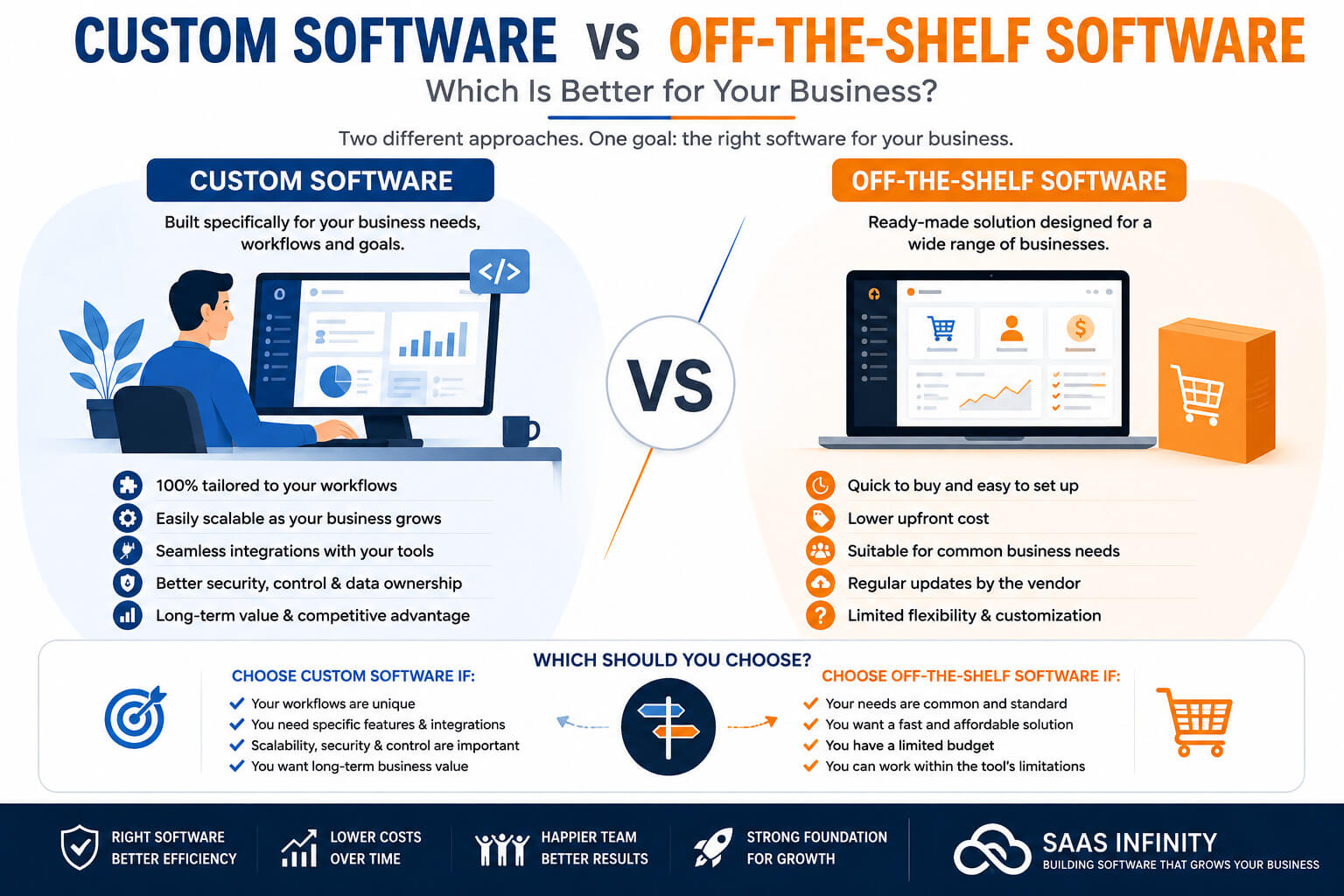
Custom software vs off-the-shelf software is about choosing between software built specifically for your business and ready-made software available to many businesses. Custom software is better when you need specific workflows, integrations, automation, scalability and ownership. Off-the-shelf software is better when you need a quick, lower-cost solution for common business tasks.
- Choose custom software if your business process is unique or you need full control.
- Choose off-the-shelf software if your needs are simple and you want a fast setup.
- Compare both based on cost, flexibility, integrations, scalability, support and long-term value.
Contents
- Custom Software vs Off-the-Shelf Software: Overview
- Quick Comparison Table
- What Is Custom Software?
- What Is Off-the-Shelf Software?
- Benefits of Custom Software
- Benefits of Off-the-Shelf Software
- Cost Comparison
- Scalability and Long-Term Growth
- Integration and Automation
- Security, Ownership and Control
- Which Option Should Your Business Choose?
- Common Mistakes to Avoid
- How SaaS Infinity Can Help
- Frequently Asked Questions
- Final Thoughts
Custom Software vs Off-the-Shelf Software: Overview
Every growing business eventually reaches a point where basic tools, spreadsheets and manual processes are no longer enough. You may need software to manage customers, staff, operations, stock, bookings, invoices, leads, reporting, compliance or internal workflows. At that stage, one important question appears: should your business use ready-made software or build a custom solution?
The debate around custom software vs off-the-shelf software is not about which option is always better. The right choice depends on your business goals, budget, timeline, workflow complexity, integration needs and long-term growth plan.
Off-the-shelf software can be useful when your business needs are common and you want a quick setup. For example, accounting software, email marketing tools, basic CRM systems and project management platforms can work well for many businesses.
Custom software is different. It is designed around your exact process. This can include a custom CRM, staff management system, client portal, booking system, SaaS platform, workflow automation tool, reporting dashboard, mobile app or web application.
At SaaS Infinity, we help UK businesses plan, design and build custom software, web applications, mobile apps, CRM systems and SaaS platforms that support real business workflows.
Important note
Do not choose software only because it is cheap or popular. Choose software based on your workflow, business goals, team needs, data requirements, integrations and long-term value.
Quick Comparison Table
The table below gives a simple business-focused comparison of custom software and off-the-shelf software.
| Factor | Custom Software | Off-the-Shelf Software |
|---|---|---|
| Built for | Your exact business needs and workflows. | General needs used by many businesses. |
| Setup speed | Takes longer because it requires planning, design and development. | Usually faster to start using. |
| Initial cost | Usually higher upfront investment. | Usually lower upfront cost or monthly subscription. |
| Flexibility | Highly flexible and can be changed around your process. | Limited by available features and plan restrictions. |
| Scalability | Can be built to grow with your business. | May become limited as your business grows. |
| Ownership | More control over features, data and roadmap. | Controlled by the software vendor. |
What Is Custom Software?
Custom software is software designed and developed specifically for one business or organisation. It is built around your process, your users, your data, your integrations and your long-term business goals.
Instead of adjusting your business to fit a ready-made tool, custom software is built to fit the way your business works. This can make it especially useful for businesses with unique operations, complex workflows, multiple user roles or specific reporting needs.
Examples of custom software include:
- Custom CRM system
- Student recruitment CRM
- HR management system
- Booking and appointment platform
- Customer portal
- Staff dashboard
- Inventory management system
- Lead management platform
- Compliance tracking system
- Workflow automation system
- Mobile app with backend dashboard
- SaaS platform for external users
Custom software is usually best when your business has outgrown spreadsheets or generic tools and needs a system that supports its own way of operating.
What Is Off-the-Shelf Software?
Off-the-shelf software is ready-made software that is available for many businesses to use. It is usually sold as a subscription, licence or one-time product. The software is already built, so businesses can usually start using it quickly.
Common examples include accounting tools, email marketing platforms, project management apps, basic CRM systems, HR tools, booking software and communication platforms.
Off-the-shelf software can be a good choice when:
- Your business needs are simple.
- You want to start quickly.
- Your budget is limited.
- You do not need special workflows.
- The software already solves your problem well.
- You are happy to work within the tool’s limitations.
The main limitation is that off-the-shelf software is built for a broad market. It may include features you do not need and miss features that are important for your business.
Benefits of Custom Software
1. Built around your workflow
The biggest benefit of custom software is that it can be designed around the way your business actually works. Your team does not need to force its process into a generic system.
2. Better automation
Custom software can automate repetitive tasks such as lead assignment, document reminders, reporting, status updates, invoice generation, approval flows and customer notifications.
3. Stronger integration
A custom system can be connected with your website, CRM, accounting tool, payment gateway, email platform, SMS provider, WhatsApp tools, mobile app or internal database.
4. More control
With custom software, your business has more control over features, user permissions, data structure, reports and future improvements.
5. Long-term scalability
Custom software can be built in phases. You may start with a minimum viable product and then add more features as the business grows.
Benefits of Off-the-Shelf Software
1. Faster setup
Off-the-shelf software is already built, so your business can usually sign up and start using it quickly. This is helpful when you need a quick solution.
2. Lower upfront cost
Many ready-made tools use monthly subscriptions, which may be easier for small businesses than paying for full custom development upfront.
3. Existing support and documentation
Popular software tools often include help centres, tutorials, customer support, templates and integrations.
4. Regular updates
Software vendors usually maintain and update their products. This can reduce the technical burden on your business.
5. Good for standard tasks
If your business needs are common, ready-made software may be enough. For example, simple accounting, task management or email marketing may not need custom development.
Cost Comparison
Cost is one of the biggest factors when comparing custom software vs off-the-shelf software. Off-the-shelf software often looks cheaper at the start, while custom software usually needs a higher upfront investment.
However, the cheapest initial option is not always the cheapest long-term option. Monthly subscriptions, add-ons, user limits, feature restrictions, integration costs and manual work can increase the true cost of off-the-shelf software over time.
Custom software may cost more at the beginning, but it can reduce manual work, improve efficiency and support workflows that ready-made tools cannot manage properly.
| Cost Area | Custom Software | Off-the-Shelf Software |
|---|---|---|
| Initial cost | Higher due to planning, design and development. | Lower because the software already exists. |
| Monthly cost | Depends on hosting, support and maintenance. | Often subscription-based per user or per feature. |
| Customisation cost | Built into the project plan. | May be limited or require expensive add-ons. |
| Long-term value | Can create a business asset and improve efficiency. | Useful if the tool continues to fit business needs. |
Scalability and Long-Term Growth
Scalability means how well the software can support your business as it grows. This includes more users, more customers, more data, more locations, more workflows and more integrations.
Off-the-shelf software may scale well up to a point, especially if the vendor offers higher plans. However, your business may eventually reach a limit where the software cannot support your exact process.
Custom software can be designed with growth in mind. For example, a business may start with a basic CRM and later add:
- Customer portal
- Staff mobile app
- Advanced reporting dashboard
- Payment integration
- Document management
- Role-based access
- Branch or location management
- API integrations
- AI-powered automation
If your business has a long-term digital roadmap, custom software may provide better flexibility.
Integration and Automation
Integration is often where off-the-shelf software becomes difficult. Many ready-made tools offer integrations, but they may not connect exactly the way your business needs.
For example, your business may need your website enquiry form to create a CRM lead, assign it to a team member, send a WhatsApp notification, create a follow-up task and update a reporting dashboard. A generic tool may require several paid add-ons or manual workarounds to achieve this.
Custom software can be built to connect systems around your workflow. This can reduce manual admin and improve data accuracy.
Common integrations include:
- Website forms
- CRM systems
- Accounting software
- Payment gateways
- Email marketing platforms
- SMS or WhatsApp tools
- Booking calendars
- Google Analytics or reporting dashboards
- Mobile apps
- Third-party APIs
Security, Ownership and Control
Security and control are important when choosing business software. Off-the-shelf software vendors usually manage security, hosting and updates. This can be convenient, but your business has limited control over how the platform changes.
With custom software, security can be planned around your business requirements. This may include user permissions, audit logs, secure data storage, access control, backups and compliance-focused workflows.
Ownership also matters. With off-the-shelf software, your business normally pays to use the platform. With custom software, you may have more control over the system, feature roadmap and data structure depending on the agreement with your development partner.
Before choosing either option, ask:
- Where is the data stored?
- Who can access the system?
- Can user permissions be controlled?
- Can data be exported?
- What happens if you stop using the software?
- How are backups managed?
- Who is responsible for updates and maintenance?
Which Option Should Your Business Choose?
The decision between custom software and off-the-shelf software should be based on your business needs, not only cost.
Choose custom software if:
- Your workflow is unique.
- Generic tools do not fit your process.
- You need automation across multiple systems.
- You need custom reports or dashboards.
- You want better control over features and data.
- You are building a SaaS platform or digital product.
- You need customer portals, staff dashboards or complex user roles.
- You want software that can grow with the business.
Choose off-the-shelf software if:
- Your needs are simple and common.
- You need a fast setup.
- You have a limited budget.
- You do not need special workflows.
- You are happy to use the features already available.
- Your business is still testing processes before investing in custom development.
Many businesses start with off-the-shelf software and later move to custom software when they outgrow it. This is a normal progression for growing companies.
Common Mistakes to Avoid
When comparing custom software vs off-the-shelf software, businesses often make decisions too quickly.
Avoid these common mistakes:
- Choosing software only because it is cheap.
- Choosing a popular tool without checking workflow fit.
- Ignoring long-term subscription costs.
- Forcing your team to use a system that does not match the process.
- Not checking integration options.
- Not planning user roles and permissions.
- Ignoring data ownership and export options.
- Building custom software without a clear scope.
- Trying to build too many features in version one.
- Not planning maintenance and support after launch.
The best approach is to map your workflow first. Then decide whether a ready-made tool can support it or whether custom development is needed.
How SaaS Infinity Can Help
SaaS Infinity helps UK businesses plan, design and build custom software, web applications, mobile apps, CRM systems, SaaS platforms and automation tools.
If you are comparing custom software vs off-the-shelf software, SaaS Infinity can help you understand whether your business needs a ready-made tool, a custom system or a phased approach.
SaaS Infinity can support:
- Software discovery and workflow mapping
- Custom CRM development
- Business process automation
- Web application development
- Mobile app development
- Customer portal development
- Admin dashboard development
- SaaS platform development
- API and third-party integrations
- Reporting dashboards
- Ongoing software maintenance and support
SaaS Infinity also provides web development, mobile app development, custom CRM solutions and digital marketing support for growing businesses.
Need software built around your business?
SaaS Infinity can help you plan, design and build a custom software solution that matches your workflow, improves efficiency and supports long-term growth.
Contact SaaS Infinity
to discuss your software project.
Frequently Asked Questions
What is the difference between custom software and off-the-shelf software?
Custom software is built specifically for your business needs. Off-the-shelf software is ready-made and designed for many businesses to use.
Is custom software better than off-the-shelf software?
Custom software is better when your business has unique workflows, complex integrations or specific reporting needs. Off-the-shelf software is better when your needs are simple and you want a quick setup.
Is custom software more expensive?
Custom software usually has a higher upfront cost because it is planned and developed around your business. However, it can provide stronger long-term value if it reduces manual work and supports growth.
When should a business move from off-the-shelf software to custom software?
A business should consider custom software when ready-made tools no longer fit the workflow, create too much manual work, limit growth or fail to integrate properly with other systems.
Can SaaS Infinity build custom software?
Yes. SaaS Infinity can help UK businesses plan, design and develop custom software, CRM systems, web applications, mobile apps, SaaS platforms and automation tools.
Can custom software integrate with existing tools?
Yes. Custom software can often be designed to integrate with websites, CRMs, payment systems, email platforms, accounting tools, booking systems and third-party APIs.
Final Thoughts
Custom software vs off-the-shelf software is an important decision for any business planning digital growth. Off-the-shelf software can be fast, affordable and useful for standard tasks. Custom software can provide better flexibility, automation, integration and long-term control.
The right choice depends on your current needs and future plans. If your business only needs a simple tool, off-the-shelf software may be enough. If your business has unique workflows, growth plans, complex reporting or integration requirements, custom software may be the better long-term investment.
Before deciding, map your workflow, list your must-have features, check integration needs, compare long-term costs and consider how the software will support your team as the business grows.
SaaS Infinity helps UK businesses build custom software, CRM systems, web applications, mobile apps, SaaS platforms and digital systems designed around real business needs.
Methodology and Source Notes
This article has been written as a practical guide for UK businesses comparing custom software and ready-made software. It uses SaaS Infinity’s software development context and common business technology considerations, including workflow fit, cost, scalability, integrations, ownership, automation and long-term value.