
Quick answer
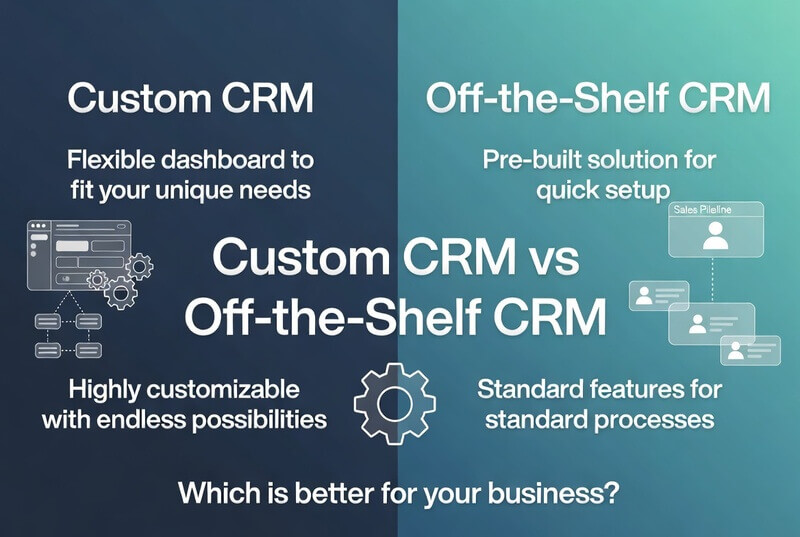
When comparing Custom CRM vs Off-the-Shelf CRM, the right choice depends on your business size, workflow, budget, growth plan and data needs. An off-the-shelf CRM can be quicker to launch and useful for standard sales or customer management. A custom CRM is built around your exact business process, making it better for companies that need tailored workflows, automation, integrations, reporting and long-term scalability.
Contents
- Custom CRM vs Off-the-Shelf CRM: Overview
- What Is a CRM System?
- What Is a Custom CRM?
- What Is an Off-the-Shelf CRM?
- Custom CRM vs Off-the-Shelf CRM Comparison Table
- Benefits of Custom CRM Development
- Benefits of Off-the-Shelf CRM Software
- CRM Cost Comparison
- Which CRM Is Best for Your Business?
- Common CRM Mistakes Businesses Make
- How SaaS Infinity Can Help
- Frequently Asked Questions
- Final Thoughts
Custom CRM vs Off-the-Shelf CRM: Overview
Customer relationship management is one of the most important parts of modern business growth. Whether you run a recruitment agency, healthcare company, estate agency, hospitality business, consultancy, service company or SaaS startup, managing leads, customers, follow-ups, documents and sales activity in one place can save time and reduce mistakes.
Many businesses start by using spreadsheets, email inboxes, WhatsApp messages and manual notes to manage customers. This may work in the early stage, but as enquiries increase, the process becomes harder to control. Leads get missed, follow-ups are delayed, customer information is scattered and reporting becomes unreliable.
This is where CRM software becomes useful. A CRM system helps businesses manage customer data, sales pipelines, communication history, tasks, reminders, documents, reports and team activity. The challenge is deciding whether to choose a ready-made CRM platform or invest in a CRM built specifically for your company.
The debate around Custom CRM vs Off-the-Shelf CRM is not simply about price. It is about control, flexibility, speed, scalability, ownership, user experience and long-term business value. An off-the-shelf CRM can be fast and convenient, but it may force your team to work around the software. A custom CRM can be more expensive at the start, but it can be built around the exact way your business operates.
At SaaS Infinity, we help UK businesses plan, design and build custom CRM systems, bespoke software, websites, mobile apps, SaaS platforms and AI-powered digital solutions.
Important note
There is no single CRM solution that is right for every business. The best choice depends on your workflow, industry, data structure, team size, budget, integration needs and growth plan.
What Is a CRM System?
CRM stands for Customer Relationship Management. A CRM system is software that helps businesses manage relationships with leads, prospects, customers, partners and clients.
A CRM can help your business manage:
- Lead records and customer profiles
- Sales pipeline stages
- Customer enquiries and follow-ups
- Notes, call history and email activity
- Documents and compliance files
- Tasks, reminders and team activity
- Quotes, proposals and invoices
- Marketing campaigns and customer segmentation
- Reports, dashboards and performance tracking
- Automation between departments or tools
For small businesses, a CRM can make day-to-day work more organised. For growing companies, it can become the central system that connects sales, operations, marketing, customer service and management reporting.
A good CRM should not only store data. It should help your team take action, reduce admin time, improve visibility and support better business decisions.
What Is a Custom CRM?
A custom CRM is a customer relationship management system built specifically for your business. Instead of using a standard platform with generic features, a custom CRM is designed around your company’s workflow, departments, users, data, reporting needs and long-term goals.
Custom CRM development may include:
- Custom lead management workflow
- Role-based dashboards for staff, managers and directors
- Industry-specific data fields
- Custom reporting and analytics
- Automated follow-up reminders
- Document upload and approval systems
- Email, SMS or WhatsApp notification integration
- API integration with third-party tools
- Customer portals or client login areas
- AI-powered automation or reporting features
A custom CRM is especially useful when your business has a process that does not fit neatly into ready-made software. For example, a recruitment company may need candidate tracking, compliance documents, interview schedules, employer records and visa expiry alerts. A property business may need landlord records, tenant enquiries, property matching and viewing schedules. A consultancy may need client onboarding, proposal tracking, document approval and project reporting.
The main advantage of a custom CRM is that it works the way your business works. Your team does not need to change important processes just to fit the limits of generic software.
What Is an Off-the-Shelf CRM?
An off-the-shelf CRM is ready-made CRM software available to many businesses. Popular CRM tools often include standard features such as contact management, sales pipelines, email tracking, task management and dashboards.
Off-the-shelf CRM software is usually subscription-based. Businesses pay monthly or annually per user, depending on the plan. These systems can be useful for companies that need a quick solution and have fairly standard customer management needs.
An off-the-shelf CRM may be suitable if your business needs:
- Basic contact management
- Simple sales pipeline tracking
- Standard email integration
- Basic reporting dashboards
- Quick setup without custom development
- Low upfront cost
- Access to existing templates and standard features
However, off-the-shelf CRM systems can become limiting when your business grows or when you need industry-specific workflows. You may have to rely on plugins, workarounds, manual exports or paid add-ons to get the functionality you need.
Custom CRM vs Off-the-Shelf CRM Comparison Table
The table below compares custom CRM development and off-the-shelf CRM software from a practical business perspective.
| Factor | Custom CRM | Off-the-Shelf CRM |
|---|---|---|
| Setup speed | Takes longer because it is planned, designed and developed for your business. | Usually faster to start because the system already exists. |
| Upfront cost | Higher upfront investment. | Lower upfront cost, usually monthly subscription-based. |
| Flexibility | Highly flexible and can be built around your workflow. | Limited by the platform’s existing structure and features. |
| Scalability | Can be designed for long-term growth and custom expansion. | May become expensive or restrictive as users and features increase. |
| Ownership | You may own the system depending on the development agreement. | You rent access to the platform and follow provider terms. |
| Integrations | Can be integrated with your exact tools and internal systems. | Integration depends on available apps, APIs and plan limitations. |
| Best for | Businesses with unique workflows, complex operations or growth plans. | Businesses with standard CRM needs and limited setup time. |
Benefits of Custom CRM Development
1. Built around your exact workflow
The biggest advantage of a custom CRM is that it can match the way your business actually operates. You can design custom lead stages, customer types, document requirements, approval steps, team roles, notifications and reports.
This is useful for businesses where standard CRM systems feel too generic. Instead of forcing your staff to use unnecessary features or awkward workarounds, your CRM can be built around the actions your team takes every day.
2. Better control over features
With off-the-shelf CRM software, you may pay for many features you never use. At the same time, the one feature you really need may only be available through an expensive plan or third-party plugin.
Custom CRM development allows you to focus on features that create real business value. You can start with the essentials and add more functionality later as your business grows.
3. Stronger automation
A bespoke CRM can automate repetitive tasks based on your business rules. For example, the system can send reminders when a lead has not been contacted, alert a manager when a deal reaches a certain stage, generate reports automatically or trigger customer emails after a form submission.
Automation reduces manual admin and helps your team focus on higher-value work such as sales, service and customer relationships.
4. Custom reporting and dashboards
Every business measures success differently. A standard CRM may offer basic sales reports, but your company may need reports based on specific branches, staff performance, lead sources, customer types, compliance status, conversion rates or revenue categories.
A custom CRM can provide dashboards that show the exact information your management team needs. This supports better planning and faster decision-making.
5. Better long-term scalability
If you plan to grow, open new branches, add new services, manage more users or launch a customer portal, a custom CRM can be designed with scalability in mind. This means the system can grow with your business instead of becoming a limitation.
For growing UK companies, this can be a major advantage. A CRM should not only solve today’s problem. It should support where the business is going next.
Benefits of Off-the-Shelf CRM Software
1. Faster to launch
Off-the-shelf CRM software is usually faster to start because the platform has already been built. You can create an account, add users, import contacts and start using basic features quickly.
This can be useful for small teams that need immediate organisation and do not have complex requirements.
2. Lower initial cost
Most off-the-shelf CRM systems use monthly or annual subscriptions. This means the upfront cost is usually lower than custom CRM development.
However, businesses should also consider the long-term cost. Subscription fees, user-based pricing, premium plans, add-ons and third-party integrations can become expensive as the team grows.
3. Standard features are already available
Ready-made CRM platforms often include common features such as contact records, pipeline stages, email tracking, task reminders and basic reports.
If your business needs are simple and standard, this may be enough. You may not need a custom system if your process fits neatly into a ready-made tool.
4. Existing support and documentation
Many popular CRM platforms provide help centres, tutorials, onboarding guides and community support. This can make setup easier for businesses that are happy to follow a standard process.
The limitation is that support may not always be tailored to your exact business workflow.
CRM Cost Comparison
Cost is one of the biggest factors when comparing Custom CRM vs Off-the-Shelf CRM. However, the cheapest option is not always the best long-term choice.
An off-the-shelf CRM may look cheaper at the start because you pay a monthly subscription. But as you add users, upgrade plans, buy add-ons and connect integrations, the monthly cost can increase.
A custom CRM usually requires a higher upfront investment because the system is planned, designed, developed, tested and deployed for your business. However, it can reduce long-term dependency on subscription platforms and give your business more control.
| CRM Type | Typical Cost Style | Main Cost Risk |
|---|---|---|
| Custom CRM | Higher upfront development cost, plus hosting and maintenance. | Poor planning can increase scope and development time. |
| Off-the-shelf CRM | Monthly or annual subscription, often per user. | Costs can rise with users, add-ons, integrations and premium plans. |
For small businesses with simple needs, off-the-shelf CRM may be a practical starting point. For companies that need strong automation, tailored reports, complex workflows or full ownership, custom CRM development may create better long-term value.
Which CRM Is Best for Your Business?
The right CRM depends on your business stage and operational needs. You should not choose a CRM only because it is popular. You should choose the system that supports how your team works and where your business is heading.
Choose an off-the-shelf CRM if:
- Your business has simple customer management needs.
- You need to start quickly.
- You have a small team and standard sales process.
- You are comfortable paying monthly subscription fees.
- You do not need complex custom workflows.
- You are happy to use existing templates and standard dashboards.
Choose a custom CRM if:
- Your business has unique processes or industry-specific requirements.
- You need custom dashboards and reports.
- You want to integrate several tools into one system.
- You need document management, approvals or compliance tracking.
- You want more control over data, workflows and user permissions.
- You are planning long-term growth and need scalable software.
- You want customer portals, AI automation or advanced business logic.
For many growing businesses, the decision is not always immediate. Some companies start with off-the-shelf CRM software and later move to a custom CRM when they outgrow the limitations.
Common CRM Mistakes Businesses Make
Choosing the wrong CRM can waste time, money and staff energy. Before choosing between custom CRM and off-the-shelf CRM, avoid these common mistakes.
- Choosing a CRM only because it is popular.
- Ignoring how your team actually works day to day.
- Paying for features your business does not need.
- Not checking long-term subscription costs.
- Not planning data migration properly.
- Using too many plugins or workarounds.
- Not training staff properly before launch.
- Failing to define sales stages and customer workflows.
- Not checking integration options with your existing systems.
- Building a custom CRM without a clear project scope.
The best CRM projects start with discovery. This means understanding the business problem, user roles, workflow, data, reporting needs, automation opportunities and future growth plan before deciding the technology.
How SaaS Infinity Can Help
SaaS Infinity helps UK businesses design and develop custom CRM systems that are built around real business needs. We work with companies that want to move away from spreadsheets, disconnected tools and manual processes.
Our CRM development support can include:
- CRM discovery and planning
- Workflow mapping
- Custom CRM design
- Lead and customer management modules
- Role-based user dashboards
- Custom reporting and analytics
- Document management and approval workflows
- Email, SMS, WhatsApp or third-party API integration
- Customer portals and staff portals
- AI-powered automation and smart reporting
- Hosting, maintenance and ongoing support
SaaS Infinity can also support your wider digital growth through software development, web development, mobile app development, SaaS platform development, AI solutions and digital marketing.
Need a CRM built around your business?
SaaS Infinity can help you plan, design and build a custom CRM system that supports your team, customers and long-term business growth.
Contact SaaS Infinity
to discuss your CRM project.
Frequently Asked Questions
What is the difference between custom CRM and off-the-shelf CRM?
A custom CRM is built specifically for your business workflow, features and reporting needs. An off-the-shelf CRM is ready-made software used by many businesses, usually with standard features and subscription pricing.
Is custom CRM better than off-the-shelf CRM?
Custom CRM can be better if your business has unique workflows, complex data, specific reporting needs or integration requirements. Off-the-shelf CRM can be better if your business needs a quick, standard and lower-upfront-cost solution.
How much does custom CRM development cost in the UK?
Custom CRM development cost in the UK depends on features, users, dashboards, integrations, automation, security and support. A simple CRM may cost less, while a complex CRM with advanced workflows and integrations can require a larger investment.
Can a custom CRM integrate with my existing tools?
Yes. A custom CRM can be integrated with tools such as websites, email platforms, accounting systems, payment gateways, marketing tools, calendars, document systems and third-party APIs.
Is off-the-shelf CRM cheaper?
Off-the-shelf CRM is usually cheaper at the start because it uses monthly subscription pricing. However, long-term costs can increase with more users, premium features, add-ons and integrations.
Can SaaS Infinity build a custom CRM for my business?
Yes. SaaS Infinity can help UK businesses plan, design and develop custom CRM systems based on their workflow, customer journey, reporting needs and growth goals.
Final Thoughts
The choice between Custom CRM vs Off-the-Shelf CRM depends on what your business needs today and what it will need in the future. If your team only needs simple contact management and basic pipeline tracking, an off-the-shelf CRM may be enough.
However, if your business needs custom workflows, automation, document management, advanced reporting, integrations, user permissions or long-term scalability, a custom CRM may be the better investment.
A CRM should help your business work faster, serve customers better and make smarter decisions. The right system should reduce confusion, improve visibility and support growth.
SaaS Infinity helps UK businesses build custom CRM systems, bespoke software, websites, mobile apps, SaaS platforms, AI solutions and digital growth systems designed around real business needs.
Methodology and Source Notes
This article has been written as a practical guide for UK businesses comparing custom CRM development with off-the-shelf CRM software. The content is based on SaaS Infinity’s software development context, common CRM use cases, business automation needs and practical CRM implementation considerations.